Miscellaneous 1950s
Miscellaneous Accessories
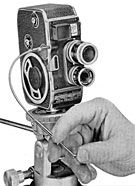
8" Cable Release 8" cable releases were included with B, C and D model cameras beginning with the B-8 in 1953. These required no adapter and were attached simply to the cable release socket located on the side of the camera. Later model cameras had sockets located directly on the side release button which accepted the same cable.
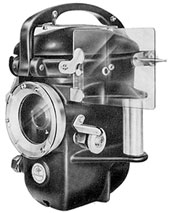
Underwater Housing This camera housing was introduced in 1955 to accommodate the H-16 for underwater filming. The unit was watertight down to depths of 330 ft. [1] Three controls were located on the outside for the operation of the lens diaphragm, motor winding and camera release. The device was equipped with a parallax corrected viewfinder and originally supplied with two diaphragm collars: one for a Switar 10mm f/1.6 and the other for either Switar 16mm f/1.8 or Yvar f/2.8 lenses. [2] Later versions were available with diaphram collars to support H-8 and RX lenses. Weight, out of water and without camera was 22lbs; 4 1/2 lbs while submerged. It sold for $430.00 US in a 1958 retail price list.
1 Myron Matzkin, "New Bolex Underwater Case," Bolex Reporter, Christmas 1956, 19.
2 Ibid., 19.
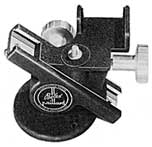
Rackover The Bolex Rackover was designed as an aid in focusing and as a means to correct parallax error for non-reflex H cameras. The camera is attached to the rackover unit, which can be placed on a tripod or flat surface. By sliding the camera up the wedge, parallax error is corrected by allowing the taking lens to occupy the same position it did when focusing with the eye level viewfinder.
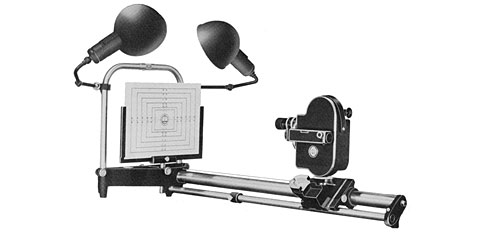
Bolex Titler The Bolex Titler allowed accurate framing and filming of titles, animation and other effects. It may have been first produced in the late 1940s; I can only date it as early as September 1950, in a price list of that date. The basic version of the device was comprised of an optical bench with a spring mounted tape measure, two lamps, title frame, rackover camera carriage and extension cord. An accessory kit was available with multiple frames, scroll device, drum, turntable, tilting plates and other items which allowed the film maker to produce a variety of effects, animation and motion titles. It was later referred to as the "Super Titler" and modified slightly throughout its production into the 1960s.
8mm Titler In 1955, Paillard introduced a titler for pocket size cameras. In order to provide accurate framing with these non-reflex cameras, a unique D mount device was designed to project a circle of light through the lens onto the titling board. The Basic Titler consisted of the titling board with a field frame and centering card, support stand and camera base, and precision centering device with 4V lamp and wire with alligator clamps for attaching to a battery.
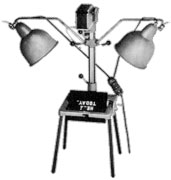
A full accessory kit could be purchased, which included two adjustable lamps, horizontal and vertical "Flip Flap" boards, drum, disc, scroll title device and 10" extension legs; all effect devices, apart from the scroll, were covered with black velvet.
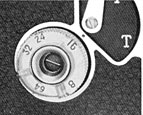
Speed Dial Knob This plexiglass accessory was advertised in the Christmas 1955 issue of the Bolex Reporter for $1.25. It was designed to fit over the speed dial of Bolex H cameras to allow adjustments to be made more easily, especially with the Bolex unimotor attached.
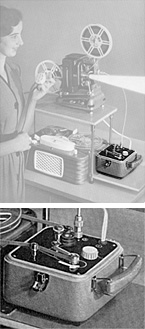
Bolex Synchromat According to a 1957 brochure, this accessory was designed to "add sound to your 8mm films" projected with the Bolex M-8 or M-8 R. Simply put, the device merely synchronized the starting of the projector with the starting of the tape recorder. It was not a device to record sound, but rather to allow music or dialog recorded on tape to be started along with the operation of the projector.
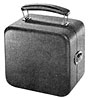
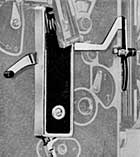
Rexofader The Rexofader was introduced in 1959 for use with the variable shutter on the H-16 REX. By pressing a lever, the device automatically opens or closes the shutter at a fixed time of 1.75 seconds (equal to 28 frames at 16fps), allowing the user to create smooth fades and dissolves. This version can be identified by a smaller downward facing lever; the later version had an upward facing lever and produced fixed fades of 40 frames. A winding crank with a longer attachment shaft was included with the Rexofader.
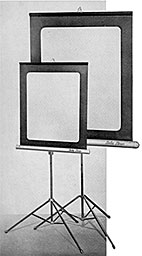
Stereo Projection Screens These projection screens were intended for films shot with the Bolex stereo system. The projection surface was coated with aluminum paint, while the edge was cropped with a light absorbing matte black finish. [3] Two sizes were available: the smaller screen had a picture size of 26" by 34" and sold for $27.50; The larger 38" by 50" screen, designed for larger audiences and a 1000 watt lamp, sold for $54.00 in 1952. [4]
3 Kenneth S. Tydings, The Bolex Movie Guide, 8th ed. (Philadelphia: Chilton Company, 1959), 107.
4 "Bolex News," Bolex Reporter, Christmas 1952, 39.
The original archive
The preserved BolexCollector.com page, exactly as captured.